


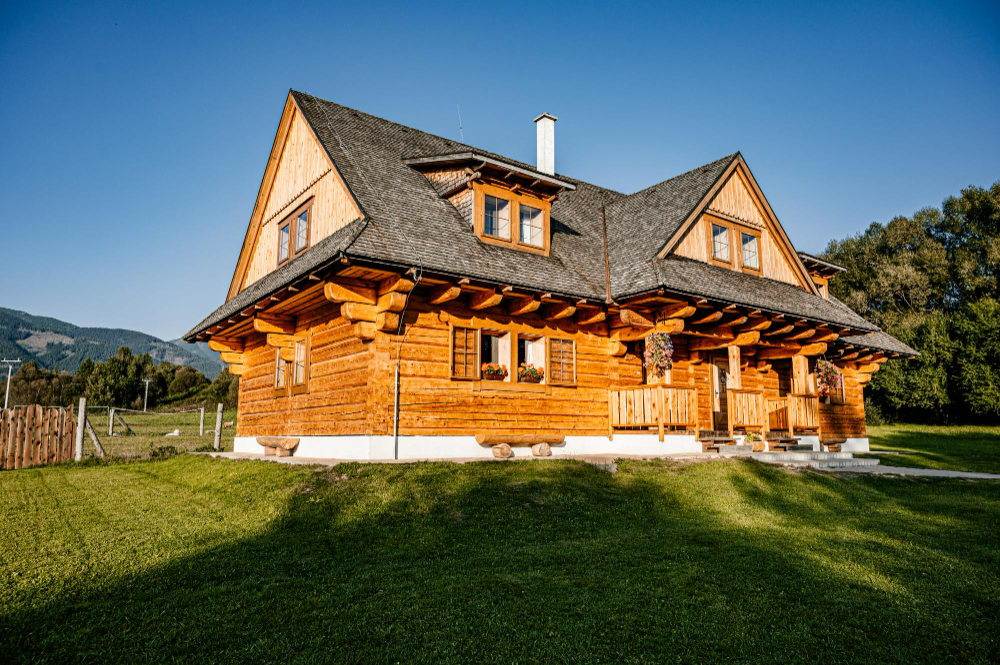
Wooden houses have a unique ‘microclimate’, but also specific requirements for air exchange. Wood reacts to moisture, and a light and airtight partition easily reveals design errors: from condensation in the wall layers to discomfort and excessive dryness of the air in winter. Well-chosen ventilation in such a building is not an accessory, but an element of structural safety and user health.
Why wooden houses have different requirements
Moisture control is particularly important in wooden structures. Wood is a hygroscopic material: it absorbs and releases water vapour, and prolonged moisture can result in the growth of fungi, degradation of structural elements and a decrease in insulation. In practice, this means that ventilation is not only responsible for removing CO₂ and odours, but above all for stabilising the moisture balance in areas where people are present and reducing the risk of condensation in partitions. The problem is often exacerbated in homes with very good air tightness (e.g. frame houses with vapour barriers and sealing tapes). In such a system, ‘natural’ leaks no longer serve the purpose of random air exchange, so without a consciously designed system, it is easy to end up with stuffiness, increased humidity in bathrooms and kitchens, or, conversely, dryness if the ventilation is too intense.
Thermal inertia is also important. Many wooden houses heat up and cool down faster than brick buildings, which means that any uncontrolled air exchange has a greater impact on bills and comfort. Added to this are acoustic issues: lightweight structures transmit sound differently, so poorly selected ducts, diffusers or excessive air speeds can cause audible noise. Ventilation design in timber should therefore balance four areas: humidity, energy, comfort and durability of partitions.
Gravity and hybrid ventilation: when it makes sense and when it doesn’t
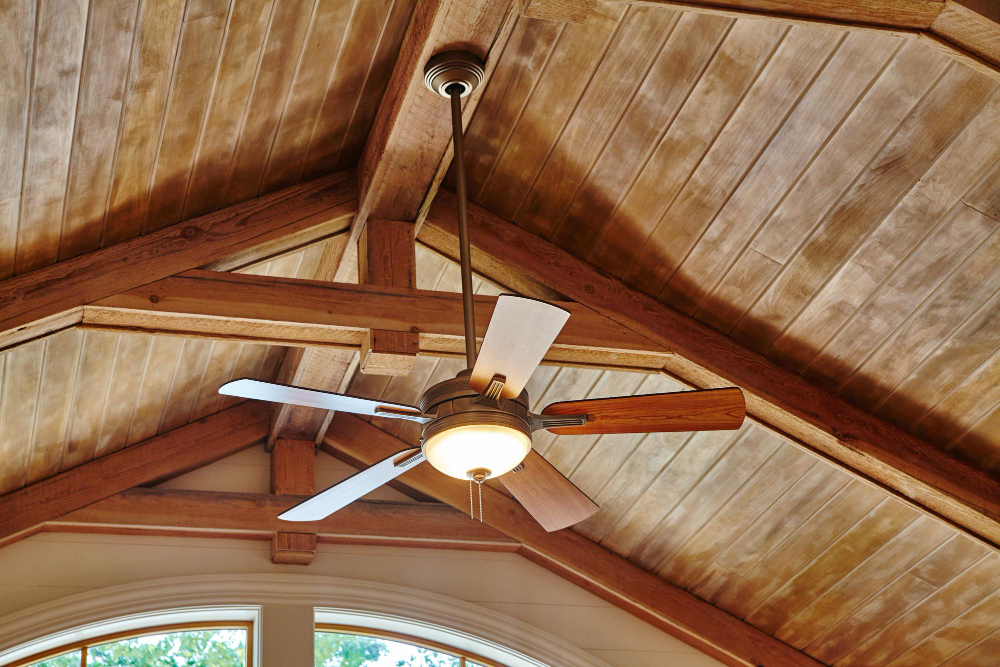
Gravity ventilation is based on the difference in air density and chimney draught, and its effectiveness depends on the outside temperature, wind and height of the ducts. In modern, airtight wooden houses, this solution is difficult to ‘control’ because it is unstable: in winter, it can ventilate too much (cooling and drying out), and in transitional periods and in summer, it often practically disappears. The result is fluctuations in air quality and humidity, and users resort to opening windows, which is unpredictable and compromises comfort and safety. In addition, in houses with a fireplace or other combustion device, it is particularly important to avoid negative pressure, which can disrupt the flue gas draught. With gravity, this is difficult to control, especially when a cooker hood is in operation in the building.
A variation is hybrid ventilation, i.e. gravity assisted by caps or fans on ducts, controlled, for example, by a humidity sensor. This can be a sensible compromise in modernised buildings or where, for various reasons, the installation of supply and exhaust ducts is not planned. Hybrid ventilation improves repeatability and reduces extremes, but still does not provide the same control over heat recovery and air balance as a mechanical system. In wooden houses, it is important to ensure an organised air supply (air vents, appropriate gaps under doors, unobstructed passageways), otherwise air will be ‘sucked’ from undesirable places: through partitions, from the garage, from the attic space or from leaks in the foundation area. This increases the risk of moisture transport in partitions and deteriorates air quality.
Mechanical ventilation with heat recovery: a standard that protects the structure
In practice, the most predictable solution for a wooden house is mechanical supply and exhaust ventilation with heat recovery. Its advantage lies in constant, controlled air exchange regardless of the weather and in reducing energy losses through recuperation. Importantly in the context of wood, stable air flows help to keep humidity under control. If the system is well designed, moisture from the kitchen, bathrooms and laundry room is effectively removed before it ‘enters’ the partitions. At the same time, air supply to rooms and bedrooms improves breathing comfort and reduces the problem of high CO₂ concentrations at night.
However, the details of the design are important. Firstly: air balance. The system should operate in a balanced manner (similar amounts of supply and exhaust air) so as not to generate constant negative or positive pressure, which can push air into partitions or suck it in through leaks. Secondly: filtration and hygiene. Wooden houses are often chosen for health reasons, so it is worth ensuring that filters of appropriate classes are used and regularly serviced to prevent the installation from becoming a dust ‘distributor’. Thirdly: noise and resistance reduction. Too small duct diameters, sharp elbows and excessive flow velocities cause noise, which is more noticeable in lightweight structures. Good practices include acoustic silencers, careful location of the control unit (e.g. in a technical room) and selection of anemostats to ensure low speeds in the occupied zone.
Finally, there is the issue of humidity in winter. Heat recovery itself does not magically ‘dry’ the air, but in buildings with low heat loss, the air can be dry due to heating and low absolute humidity outside. In such cases, performance control (e.g. reduction at night, absence mode), humidity sensors and, if necessary, central or spot humidification can help. The most important thing is not to chase a single indicator, but to maintain conditions that are safe for users and partitions.

Integration with partition layers and operation: common mistakes and best practices
In a timber house, ventilation cannot be considered separately from building physics. What happens to water vapour depends on the arrangement of layers: vapour barrier, wind barrier, tightness of joints and the method of installation. A classic mistake is perforating the vapour barrier without sealing the passages (cables, boxes, pipes), which creates local ‘chimneys’ for moist air. If there is negative pressure in the building, air will readily penetrate the partition, cool down and release moisture in places where it should not appear. Therefore, when designing ventilation, it is worth designing airtight zones and the layout of the installation in parallel to limit the number of uncontrolled penetrations.
The selection and setting of operating modes is also very important. Many problems arise not from the technology itself, but from its use: turning off ventilation ‘because it’s cold’, prolonged use of the maximum mode, failure to replace filters, closing transfer grilles or undercutting doors. Good practice is to adopt a base capacity tailored to the number of household members and actual usage, followed by short, intensive ventilation in situations of increased moisture emission (bathing, cooking, drying laundry). In the kitchen, it is worth separating the functions of the hood and ventilation: a high-performance hood, especially an extractor hood, can upset the air balance and cause suction from undesirable places. The solution is often a closed-circuit hood (with filters) or an extractor hood with a guaranteed supply of compensatory air.
Finally: control and measurement. In wooden houses, it is worth using CO₂ and humidity sensors, as they quickly show whether the system is working properly. It’s a bit like a dashboard in a car: you can drive without it, but why, when it’s there to warn you before something starts smoking. Regular servicing of the control unit, inspection of anemometers, cleaning of ducts at reasonable intervals and checking the tightness of connections are not ‘frills’, but a way to maintain stable conditions in a wooden structure for years to come.

Zarządzanie sprzedażą – odpowiada za kompleksową obsługę procesów sprzedażowych, analizę rynku oraz przygotowywanie ofert dostosowanych do potrzeb klientów.
Doradztwo techniczne HVAC – zapewnia specjalistyczne wsparcie w zakresie doboru, konfiguracji i eksploatacji urządzeń HVAC, dostosowanych do konkretnych projektów.
Koordynacja projektów – nadzoruje realizację inwestycji, współpracując z zespołami technicznymi i kontrolując działania podwykonawców, by zapewnić terminowość i jakość wykonania.
Serwis i montaż – organizuje i nadzoruje prace instalacyjne oraz serwisowe, dbając o sprawne wdrożenie systemów.
Sprzedaż i doradztwo produktowe – współpracuje z instalatorami, projektantami oraz deweloperami, oferując rozwiązania w zakresie wentylacji, rekuperacji i chłodnictwa.
Tworzenie ofert i wycen – przygotowuje konkurencyjne propozycje handlowe, opierając się na szczegółowej analizie kosztów i oczekiwań klienta.
- Ventilation in server rooms — cooling data of great importance - 25 November 2025